- Jesus' birth and life showed the kingdom was inaugurated (Mark 1:14-15). Jesus clearly taught that this kingdom was a spiritual kingdom (John 18:36). Entering his kingdom require a spiritual rebirth (John 3:3).
- His ministry, especially his death and resurrection bind Satan so his house can be plundered (Matthew 12:29, Mark 3:27, Revelation 20:1-3). Note specifically in the Revelation 20 passage, the binding of Satan means he is not free to deceive the nations any more, not that his activity has completely ceased. He is still free to harass the church, as much of Revelation depicts; however, people from every nation and tribe will be welcomed into the kingdom.
- The outpouring of the Holy Spirit signals that we are in the last days (Joel 2:28-32, Acts 2:14-21). The last days covers the whole span of history from Christ's first advent to his second coming. The last days are marked by the unique and climactic revelation of God in His Son (Heb. 1:2), by the unprecedented scope of the Spirit's work (Joel 2:28-32), scoffers (2 Peter 3:3), godlessness and difficulties (2 Timothy 3:1-5). John refers to this time period as 'the last hour' during which the church must be on guard against 'antichrists' (1 John 2:18).
- The last hour and last days will climax in 'the last day' (The Day of the Lord) in which Jesus promises to raise up all those who have been given to him (John 6:39-44; John 6:54). It will also be a day when those who reject Christ will be judged (John 12:48). As the Day of the Lord is still in the future, the church is active in preaching the gospel, urging rebels to accept the amnesty the King is offering (2 Corinthians 5:18-20).
- The kingdom is a present reality. Saints are presently reigning with Christ who is presently on his throne. Here taking a close look at Revelation 20 is in order:
[20:1] Then I saw an angel coming down from heaven, holding in his hand the key to the bottomless pit and a great chain. [2] And he seized the dragon, that ancient serpent, who is the devil and Satan, and bound him for a thousand years, [3] and threw him into the pit, and shut it and sealed it over him, so that he might not deceive the nations any longer, until the thousand years were ended. After that he must be released for a little while.
[4] Then I saw thrones, and seated on them were those to whom the authority to judge was committed. Also I saw the souls of those who had been beheaded for the testimony of Jesus and for the word of God, and those who had not worshiped the beast or its image and had not received its mark on their foreheads or their hands. They came to life and reigned with Christ for a thousand years. [5] The rest of the dead did not come to life until the thousand years were ended. This is the first resurrection. [6] Blessed and holy is the one who shares in the first resurrection! Over such the second death has no power, but they will be priests of God and of Christ, and they will reign with him for a thousand years.
(Revelation 20:1-6 ESV)
It is my understanding that the number 1000 is symbolic - as are virtually all the numbers in the book of Revelation - representing a full period of time. Moreover, I don't think it is appropriate to read the book of Revelation as though it proceeded chronologically. Revelation 19 depicts the climatic battle between Satan and God. On my view, Revelation 20 happens prior to that battle. Much of Revelation is cyclical. As I understand it, Revelation 20:1-15 is the seventh cycle of the book, each one recording the same period of history, adding vivid imagery to give us a composite picture. The binding of Satan refers to the the limitation of Satan's power by Christ so that the church would be successful in fulfilling its Great Commission (see above). The battle of Revelation 20:7-10 is the same battle as Revelation 19:11-21.
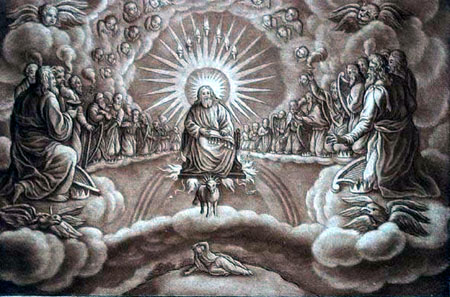 I believe the saints are reigning above with Christ now, not in future kingdom on earth. What John sees are the disembodied souls of the saints in heaven (see also Rev. 6:9). I don't think the privilege of reigning is necessarily limited to the martyrs, but the martyrs (those beheaded) is a subset of all the faithful 'who had not worshiped the beast or its image.' Scripture makes it clear that Christ is already reigning on the throne (Eph 1:19-23).
What about the 'first resurrection', 'first death', 'second resurrection', and 'second death'? As I understand it, there is a neat symmetry here. The first resurrection and the second death are spiritual in nature. The first resurrection refers to the believers rebirth, from being brought back from the dead spiritually (Eph. 2:1-5, Col. 2:12-13). The second death is the unbelievers spiritual death - an eternal death (Matthew 10:28). The first death is a physical death that all will experience (except for those alive when Christ returns). The second resurrection is a physical resurrection all will experience (except those alive when Christ returns). Believers will experience this second resurrection, a reuniting of the bodies and souls for a blessed eternity; unbelievers will experience this resurrection for judgment.
1 Corinthians 15 is also helpful:
[20] But in fact Christ has been raised from the dead, the firstfruits of those who have fallen asleep. [21] For as by a man came death, by a man has come also the resurrection of the dead. [22] For as in Adam all die, so also in Christ shall all be made alive. [23] But each in his own order: Christ the firstfruits, then at his coming those who belong to Christ. [24] Then comes the end, when he delivers the kingdom to God the Father after destroying every rule and every authority and power.
[25] For he must reign until he has put all his enemies under his feet. [26] The last enemy to be destroyed is death. [27] For “God has put all things in subjection under his feet.” But when it says, “all things are put in subjection,” it is plain that he is excepted who put all things in subjection under him. [28] When all things are subjected to him, then the Son himself will also be subjected to him who put all things in subjection under him, that God may be all in all.
(1 Corinthians 15:20-28, ESV)
Paul says in verse 24 that the end will come after Christ has destroyed every rule and every authority and power. That process is begun and will conclude at the climatic battle on the Day of the Lord. Paul specifically says the last enemy to be destroyed will be death (v. 26). That, the resurrection of the dead and the casting of Death and Hades into hell, marks the absolute end.
After that we enter into the eternal state, the New Heavens and New Earth (Rev. 20:11-21:8). There is not intermediate 1000 kingdom on earth in my view.
A few more points:
- The church will be successful in winning people for Christ from every tribe and nation. However, that does not mean the world will be Christianized (see the Parable of the Weeds, Matthew 13:24ff).
- All the promises made to Abraham and David are fulfilled in Christ (the True Israel of God) and his Church (see second point in my post 'Should the US Support Israel'). Hence, there is no interpretive need for an earthly millennium.
- The kingdom will not be established by the work of the church. Christ alone will establish his kingdom when he returns in glory.
- Maranatha. Come Lord Jesus!
A few really good books on Revelation:
1.The Returning King: A Guide to the Book of Revelation
 , by Vern Poythress
2. Triumph of the Lamb: A Commentary on Revelation
 , by Dennis Johnson
3. Case for Amillennialism, A: Understanding the End Times
 , by Kim Riddlebarger




 . In the short book, Enn's asserts that the Biblical accounts of beginnings are similar to other Ancient Near Eastern accounts and should be considered myth, not historical fact. Since his departure, he has gone on to question the historicity of Adam and Eve, arguing that they "could be viewed symbolically as a story of Israel’s beginnings, not as the story of humanity from ground zero." Of Enn's theology as outlined in the book, Bruce Waltke, OT Professor at Reformed Theological Seminary commented, "Each of us has his or her own walk with God; in that connection I do not call into question Enns’s integrity. I know he is a man of unflinching honesty. But as for me, his theology is unstable and the exegesis that supports it is flawed."