Pages

Showing posts with label ethics. Show all posts

Monday, December 05, 2011

My Response: Ethics, Church & Undocumented Workers

I thought I would get to writing on this a week or so ago, but better late than never. If you want to read through the question posed by Dr. Moore go here. The question reminded me how fallen our world is and how complicated situations are. It's easy to sloganeer our way through issues like immigration and undocumented workers, but when you really enter the situation you see how convoluted and confusing it is.

In situations like Pablo's where he seems stuck between two conflicting norms - obey the law and provide for your family, there exists three main positions. First, some hold what is termed a "conflicting absolutes" or "lesser of two evils" position. Basically, Christians holding this position argue that in our fallen world, sometimes two or more principles of moral behavior will conflict absolutely and there is no option in such situations but to sin. If that is the case, the Christian should weigh in the balance the two options, choose the lesser of the two evils, and then 'sin boldly', but repent later. So, Pablo should continue to live and work in the States, providing for his family, he should confess it as sin (this assumes, of course, that the value of Pablo's family is deemed to be greater than the value of obeying a arguably unjust law that would make their survival impossible).

The second position is sometimes labeled "hierarchical-ism". Those in this camp hold that there is an ordered hierarchy of absolutes, "such that some values have priority over others." When these values conflict and it's impossible to follow both absolutes, one should act according to the higher norm. Sounds a lot like the first, except that those who hold to a hierarchical view don't see the violation of the lesser norm as sin, not when it is in conflict with a greater norm. So, Pablo should continue to live and work in the States and feel no guilt, nor feel the need to confess it as sin (again, assuming that we put a higher premium on Pablo's family than national borders).

The third position is one of "non-conflicting absolutes". Proponents of this view argue that even when absolutes seem to conflict, in reality there is always a 'third way' out of the situation that avoids sin. Not to opt for the third way is sin. Pablo, on this view, should look for a third alternative which most certainly exists. Maybe he can get a better job than he thinks in his country of origin and continue to provide for his family. Maybe he could hire a lawyer and fight for legal status, etc.

Each position has it's strengths and weaknesses. The first is certainly counter intuitive - that God would hold someone as guilty of sin when they were constrained by the situation to commit a sinful act. The second position runs into the problem of a lack of biblical support. Nowhere do we encounter a hierarchy of sins or of norms, or any clear teaching that God will exempt us from the guilt of sinning if a higher good was in view (Rom. 3:7-8). Furthermore, that is certainly a slippery slope to Machiavellianism. The third position seems naive, but seems to line up with the biblical data best. Some have argued that to deny this third position, the "non-conflicting absolute" position, raises questions about God's ability to provide and about our faith in God's provision. Additionally, there is the biblical witness that God will provide a way of escape from sin/temptation (1 Cor. 10:13). Most importantly regarding the third position is the WWJD question. Yes, I'm being serious. The first position ("conflicting absolutes) raises questions about Jesus' sinlessness. If Jesus was tempted like we are, and if some of our temptations put us in situations where sin is inevitable, how can we maintain Jesus was sinless. The second position avoid this by saying that even in situations like Pablo's, had Jesus chosen as Pablo did, he wouldn't have been sinning.But, as seen above, this seems to rest on dubious groups Biblically.

My position is a combination of position one and three. I believe God does provide a way of escape from sin/temptation. I believe there is a 'third way' and Jesus is pretty good proof of it. So I agree with those who hold to position three - the 'non-conflicting norms' view. However, in this fallen world, our intellects aren't as sharp as they should be. We aren't as wise as God would have us be. We don't stay in step with the Spirit as Jesus did. So, we are sometimes faced with decisions where there doesn't seem to be a 'sinless' way out of it - where norms conflict. What should we do? Here I think position one is correct - we pick the lesser of the two evils. We violate a statute regarding citizenship to feed our families. In the case of Rahab, we lie to save lives. In the case of the Hebrew midwives, we again lie to save the lives of infant babies. We violate laws that prohibit the preaching of the gospel in closed countries. We smuggle Bibles into areas where it is forbidden. In those situations where we can't see a third way we act in a way that makes value judgements and choose honor those higher values. But ignorance isn't an excuse to sin. Trust me, I've tried it with police officers before - "sir I didn't know the speed limit was 35 here" or "sir, I didn't see the stop sign". So, in such situations where we've chose sin to avoid a greater sin, we should still confess it as such and trust in the free provision of God's grace for sinners. (My position is hard for many reasons, chief among them is that it cannot be absolutized. If the life of five more valuable than the life of one. Conjuring Spock: the needs of the many outweigh the needs of the few. Yes. Does that mean I should kill and rob one to feed five. No. Can we lie to save a life, like Rahab? Yes. Should we lie about our faith in Christ to keep from becoming a martyr? No.)

So, in Pablo's case, as his pastor, I would baptize him and admit him into full communion of the church. I would counsel him to confess his sin and pray earnestly that God would show him a way to support his family without violating the law.

Regarding the employer, I think much has to do with his motivations. Is he getting rich by exploiting his undocumented workers? Or, is he providing them with employment at a fair wage so that they can support their families? Again, if he's employing Pablo to prevent him and his family from starving, I would commend him for making a tough choice given bad options - a choice that is putting him and his business at risk.

Even here in Indiana, this issues isn't one that's far off or relegated to border states. Even if it were, there are other issues we face like it, though thankfully, not frequently. Usually, we can discern a third way (more so as we grow in wisdom and in reliance on the Spirit) - maybe not one that is comfortable or enjoyable, but I think it's rare that we face a situation in which there is no clear righteous solution.

Thoughts?

Thursday, November 17, 2011

Ethics, Church & Undocumented Workers

I appreciate, though don't always agree, with Dr. Moore of SBTS. He posted this on his blog a couple of days ago - it's the final exam question for his ethics class. In light of the focus of this years Missions Conference at ECC, I thought it would be a good thing to consider some more. I'll offer my thoughts on this next week (as well as more thoughts on the implications of Natural Law like a promised). Offer your thoughts!

You find yourself far away from this ethics class, twenty years from now in your ministry, serving a church in south Florida. Pablo is a man you met, with his wife Hannah, after they attended a small-group Bible study in the home of a family in your church. Both of them, after hearing you explain the gospel, were convicted of sin and, after several weeks of conversation, both announced they were ready to confess Jesus as Lord and to follow him in baptism.

Before the baptism, though, Pablo approaches you to say that he’s not sure he meets the requirements for Christian baptism. He’s not sure he’s a repentant sinner. He sees himself as guilty, he is sorry for his sins against God and others, and he wants the forgiveness that comes through Jesus’ bloody cross, the new life that comes from Jesus’ empty tomb.

But there’s something that kindles fear in him.

Pablo tells you he is an undocumented worker, what some would call an “illegal immigrant.” Years ago he left conditions in El Salvador that, due to famine there, led him to near starvation. Moreover, he worked, like others in his village, for a multinational plantation where he was physically beaten and sexually abused. There were no other options for him, as the only employers in the country were made up of similarly exploitative companies. He slipped into this country undetected and has since lived with an artificial Social Security number he purchased on the black market, enabling him to work in this country.

Pablo’s employer knows his immigration status, but operates with a “don’t ask/don’t tell” policy when it comes to such questions about his workers. Indeed, several outside financial consultants say that, without such labor, this employer’s business would be financially unfeasible and would have to close, since there is not a sufficient employee base among native-born Americans willing to work in such a job.

The employer is Tyler Rogers, also a member of your church, one of your most Christlike people in the congregation, and he teaches the Bible in a large Tuesday night small group. It was at his family’s house that you met Pablo and Hannah, since he had been sharing the gospel with them for months and inviting them to hear more through your church.

The United States immigration policy is, if anything, more restrictive than it was when you were in ethics class at Southern Seminary. No longer can a green card be obtained by marrying a U.S. citizen, so Pablo’s marriage to Hannah is irrelevant to his immigration status. According to current law, if Pablo turns himself in, or is caught, he will face immediate deportation to El Salvador, along with a penalty making him ineligible to apply to entrance to the United States for no less than ten years.

Moreover, returning to El Salvador and applying for immigration is a process that takes, in the best of scenarios, ten years from start to finish. An admission of illegal status, plus a return to El Salvador, would mean crushing poverty, possible starvation, and almost certain bodily harm in dangerous working conditions. It would also mean being separated from Hannah for ten to twenty years.

Pablo and Hannah have three children: an eleven year-old girl, a six year-old boy, and a two year-old girl. Hannah is also pregnant with their fourth child, due next Spring.

Pablo has, since arriving in the United States, been sending a portion of his paycheck back to El Salvador, to his elderly mother who is caring for Pablo’s nieces and nephews since Pablo’s brother was killed due to the unsafe working conditions in the factory and his brother’s wife abandoned the children. Without this money, Pablo fears the children, two of whom are babies, and his mother would starve to death.

Pablo wants to do what Jesus would have him to do, to be a godly man. What do you advise him to do? If you advise him to turn himself in or to return to El Salvador, how do you square that with the biblical mandate that one who “does not provide for his own, and especially for those of his household, has denied the faith and is worse than an unbeliever” (1 Tim. 5:8)? Can you really, from that point forward, consider yourself “pro-family” or “pro-orphan” or even “pro-life”?

If you advise him to stay with his family, how is he keeping the biblical mandate to “obey the governing authorities” (Rom. 13:1)? How also is he avoiding the sin of bearing false witness, about himself and his legal status? Can you baptize Pablo? After all, is he really showing repentance from sin?

What do you do or say, if anything, about Tyler and his employment practices? If nothing, then why not?

How do you equip the congregation to understand how to deal with this situation, and what implications does it have for how you respond to the mission field where God has placed you, with a large and growing community of undocumented Latin American workers, many of whom need to hear and believe the gospel, and are watching how you respond to this family.

Walk through each step of ethical reflection, showing why you reject some options and why you embrace others. Ground your answer in Scripture, the gospel, the Christian tradition, natural law, and common grace. Think through the implications of your answer in each situation for unintended consequences, and show how those can be ethically resolved.

Monday, September 12, 2011

The Appeal of Legalism

I had an epiphany this morning in Starbucks while discussing the book The Life of a God-Made Man with my good friend Aaron. I've enjoyed the book and our discussions together, but today I was mildly frustrated with a paragraph in the chapter "A Man and His Wealth." Here's what the author, Daniel Doriani, writes,
"Being rich towards God means [seeing] that an old car can be viewed as an embarrassment or as a gift to the kingdom. If you have $40,000, which is the nobler use - to purchase one 'cool' vehicle or to provide a century of food, clothing, and Christian education for impoverished children overseas (ten children for ten years at $400 per year)?"

I certainly agree in substance with what Doriani is saying, but where do you draw the line. Should I choose a $5000 clunker of a mini-van or a reliable and comfortable $15,000 mini-van? It could certainly be argued that using the extra $10,000 could be used for more noble purposes? Ok, what about a $10 movie (which is really $20 because I never go alone)? Can I justify going to a movie or should I find a nobler use for the money?

In my conversation with Aaron this morning I was pushing for a line, a clear black and white - this is how much you can spend without feeling guilty. Then it hit me (thanks in large part to my friend). I want the line, the rule, the clear black and white, so that I won't have to wrestle with the heart issues involved. Ouch. That's pure and simple legalism of the Pharisaical variety! I wanted to say, 'There, I followed the rules. I'm good, go away guilty feelings'. (By the way, I refuse to feel guilty for going to a movie on occasion! How you spend your money isn't the point of this post really.)

We're all drawn, by our nature, to legalism. In part, I think, because it allows us to dodge tough heart issues (and in part because it fuels our pride). Steve Brown just might be right when he contends, "I believe that we show our depravity less by the bad stuff we do than by our reversion to Pharisaism" (A Scandalous Freedom: The Radical Nature of the GospelReligion & Spirituality Books)).

Friday, February 18, 2011

Should Rahab Have Lied?

This Sunday morning I'm preaching from Joshua 2:1-21. It's the familiar story of the Israelite spies encounter with Rahab. One of the interesting pieces of the story that I won't be dealing with at all on Sunday is Rahab's lie. When the king of Jericho sends men to find the spies, she tells them the spies had just left and if they hurry, they can catch up with them. This is a bold face lie, as the text makes clear. She was hiding the spies, determined to help them because she was convinced that the LORD God of Israel was the one and true God. In the end, her and her family are spared from the destruction Israel brought upon Jericho. She winds up settling in with the people of God, is in the lineage of David and eventually the Messiah. She finds her way into the hall of faith of Hebrews 11 and James commends her faith - a faith that leads to action.

But, should Rahab have lied. It seems there are three main positions on this question (and others related to it). David Howard explains these three positions well in his commentary on Joshua (NAC). First, some hold what is termed a "conflicting absolutes" or "lesser of two evils" position. Basically, Christians holding this position argue that in our fallen world, sometimes two or more principles of moral behavior will conflict absolutely and there is no option in such situations but to sin. If that is the case, the Christian should weigh in the balance the two options, choose the lesser of the two evils, and then 'sin boldly', but repent later. So, Rahab should have lied to protect the spies, but she should confess it as sin.

The second position is sometimes labeled "hierarchicalism". Those in this camp hold that there is an ordered hierarchy of absolutes, "such that some values have priority over others." When these values conflict and it's impossible to follow both absolutes, one should act according to the higher norm. Sounds a lot like the first, except that those who hold to a hierarchical view don't see the violation of the lesser norm as sin, not when it is in conflict with a greater norm. So, Rahab should have lied but she should feel no guilt and shouldn't feel the need to confess it as sin.

The third position is one of "nonconflicting absolutes". Proponents of this view argue that even when absolutes seem to conflict, in reality there is always a 'third way' out of the situation that avoids sin. Not to opt for the third way is sin. Rahab, on this view, should have done something other than she did. Maybe she should have invited the king's men to search the home and pray that God would conceal them. Maybe she should have refused to answer the question. At least one option was open to her, on this view, that wasn't sinful.

Each position has it's strengths and weaknesses. The first is certainly counter intuitive - that God would hold someone as guilty of sin when they were constrained by the situation to commit a sinful act. The second position runs into the problem of a lack of biblical support. Nowhere do we encounter a hierarchy of sins or of norms, or any clear teaching that God will exempt us from the guilt of sinning if a higher good was in view (Rom. 3:7-8). Furthermore, that is certainly a slippery slope to Machiavellianism. The third position seems naive, but, as Howard points out, seems to line up with the biblical data best. He argues that to deny this third position, the "non-conflicting absolute" position, raises questions about God's ability to provide and about our faith in God's provision. Additionally, there is the biblical witness that God will provide a way of escape from sin/temptation (1 Cor. 10:13). Most importantly, there's the WWJD question. I know, but yes, I'm being serious. The first position ("conflicting absolutes) raises questions about Jesus' sinlessness. If Jesus was tempted like we are, and if some of our temptations put us in situations where sin is inevitable, how can we maintain Jesus was sinless. The second position avoid this by saying that even in situations like Rahab's, had Jesus chosen as Rahab did, he wouldn't have been sinning.But, as seen above, this seems to rest on dubious groups biblically.

Here's my answer, and it's a combination of position one and three. I believe God does provide a way of escape from sin/temptation. I believe there is a 'third way' and Jesus is pretty good proof of it. So I agree with those who hold to position three - the 'nonconflicting norms' view. However, in this fallen world, our intellects aren't as sharp as they should be. We aren't as wise as God would have us be. We don't stay in step with the Spirit as Jesus did. So, we are sometimes faced with decisions where there doesn't seem to be a 'sinless' way out of it - where norms conflict. What should we do? Here I think position one is correct - we pick the lesser of the two evils. We lie to save a life, or two in this case. (Though, as Howard points out, we can't absolutize this either - should we lie to save our own life? Maybe? Should we lie about our faith, deny we're Christians to save our life? Like Peter. No!) But ignorance isn't an excuse to sin - trust me, I've tried it with traffic cops before - "sir I didn't know the speed limit was 35 here" or "sir, I didn't see the stop sign". So, in such situations where we've chose sin to avoid a greater sin, we should still confess it as such and trust in the free provision of God's grace for sinners.

One last word: these cases don't come up often. Rahab. Hebrew Midwives. Any others you can remember? And exceptions to the rules don't make for good theology or ethics.

Thursday, March 25, 2010

abortion: bizarre logic and a long history

The abortion issue has been on the nations mind more recently as a result of the Health Care Bill. I'm glad it's something we are talking about again (doesn't seem we have much since the election). Here's a couple of recent posts on it (followed by some thought from Olasky's Abortion Rites).

I will be the first to admit that I am now completely lost, dazed, and confused when it comes to the Health Care Bill and the political wrangling in Congress (as a disclaimer, I like the idea of universal health care even if my taxes skyrocket. If it's right, do it). The post Final FAQ on Health Care and Abortion, by Matthew Lee Anderson on the First Things website, was helpful in sorting some of it out. Here's his concluding thoughts

"As I’ve argued, the bill as it is funds abortions.

Which is why it’s so disappointing to hear facile Christian endorsements of this bill without a single acknowledgement that we have increased abortion funding significantly, overnight. Endorsing the bill without repudiating not what might be pragmatically or economically inefficient, but what is morally wrong, is simply to turn a blind eye to the substance and effect of the legislation.

And as much as we want health-care for all—and health care for all is a good—it is deeply inconsistent to claim a pro-life ethic while endorsing a bill without qualification that directly funds the intentional killing of human persons."

Recently, Piper has commented on the "Tea Parties" conscious decision not to discuss the abortion issue, claiming that we can 'ill afford' such distracting conversations in the midst of far greater concerns for the nation, like the overwhelming debt we'll be passing on to the next generations. He summarizes the bizzare logic, "Let me see if I understand this term “ill afford”. Is this it? Enormous debt will hurt our children and grandchildren. Therefore don’t talk about the lawfulness of whether they can be killed."

I've been reading Marvin Olaky's book Abortion Rites. It's eye opening. I'm reading slow because I'm reading so many other good books at the same time, but I'm sure I'll comment on it regularly here. From the preface, "Professor Olasky makes a compelling argument for employing the strategy of containment as a first step to rollback. He challenges pro-life leaders to tailor their approach to rel-world realities, to content themselves with small victories, to provide women with positive, pro-life alternatives to abortion, and to continue to fight for laws restricting abortion while not making laws their primary focus."

I had no idea our nation had such a long history (guilt) with regards to abortion. In the first chapter, Olasky examines court records (yes, people were tried for abortion, and more typically, infanticide) from the colonial and Revolutionary period. Abortion was a dangerous deal. Surgical abortion was almost always a "double killer"; therefore, most women relied on chemical abortions. This also was a tricky business. The woman would need to take enough of the poison (like Tansy Oil) to kill the child, but not so much to kill her. It shouldn't be surprising that infanticide was more common as it was by far more safe - unless you were caught and convicted.

Most of the killings were of illegitimate children. Olasky writes, "Only 2% of all Massachusetts children during the colonial period were illegitimate; 90% percent of neonates legally found to have been murdered were." Certainly many more children were conceived out of wedlock than the 2% number indicates. However, there was tremendous societal pressure for a man to legitimate the child by marrying the mother. If that did not happen, the woman could rely on the courts to enforce substantial support payments.

While 90% of the victims of abortion/infanticide were illegitimate, that total number is remarkably low because of the societal pressures (only 2% of all births in the colonial period vs. 40% in 2007). Most women wouldn't have feared financial desperation and didn't need to fear their children would have been shunned. "Colonists were," according to historian Daniel Smith, "unwilling to punish children for the sins of the parents." Olasky writes, "Repeatedly the women involved in the crimes were not only unwed but among the minority of the pregnant unmarried who fell outside the informal and legal society safety nets." Unfortunately the number of "isolated women" dramatically increased with the urbanization of the early nineteenth century, and the societal pressures waned and have all but disappeared.

As a society, we have moved not applied that pressure to fathers to legitimize and support their children. There is often the attitude that "two bad decision (to have sex before marriage and then to marry someone you don't necessarily love) don't make a right." I do not follow that, for the reasons above. The lack of such societal pressure leads to many single mothers who, in desperation, will seek abortions. Here is one non-legal way Christians can begin to reshape it's culture in ways that will reduce the numbers of abortions - call upon men to do the right thing and use the arm of church discipline when they refuse.

The second chapter of Olasky's book explores the connection between prostitution and abortion. Obviously, in an era where contraceptives were unavailable and ineffective, prostitutes would find themselves pregnant fairly often. In addition, it's easy to see why pregnancies and children weren't acceptable options for prostitutes working in the brothels. Many of the children born to prostitutes would be very ill or deformed due to the untreated syphilis ("[30% of unborn children infected with syphilis] die before birth, and only one-fourth of those who make it to birth are healthy"). Olasky computes, taking into account many factors, that the average prostitute had 1.8 abortions per year. Using well researched estimates of sixty thousand prostitutes nationwide, he suggests that "there may have been at least one hundred thousand prostitution related abortions annually in the United States on the eve of the Civil War." Olasky quotes from The Boston Medical and Surgical Journal, "There seems to be no diminution of the evil, notwithstanding the terrors which the law holds up to the view of the criminal. The murder of unborn children is fearfully common everywhere, if the great number of half-grown infant found floating in boxes upon the water, dropped in vaults, or otherwise brought to light is any evidence of the fact. Both women and men abound, in all our large cities, who have a decided and acknowledged reputation for performing the murderous operation." Add to this the words of New York police detective John Warren, "Social rimes like infanticide, that were once place on the same level as murder, are now not only looked upon with complacency but overlooked altogether, but are are defended on principle by certain theorists..."

What were Christians doing? Honestly, I don't know. Where they reaching out to prostitutes, trying to help them find a way out of that dangerous lifestyle (estimates are that a women survived for only four years as a prostitute before angry patrons, disease, drugs or the dangers of abortion took their life). Where they offering help to the pregnant prostitutes? To what degree do these statistics apply to today? Are prostitutes and women of the porn industry more likely to seek abortions? If so, is there an opportunity there for Christians to work to help the women get out of those lifestyles or to provide options other than abortion.

We think a lot about the legal aspect of the abortion debate, but clearly, as history shows, even with laws on the books criminalizing the killing of unborn children, women still sought abortions. What more can be done?

Note: I am just clarifying on this that I am writing as an individual and this blog isn't tied to ECC or the college ministry of ECC. My views, while always correct, don't necessarily represent the views of the church or all it's member.

Wednesday, March 17, 2010

Is a sexual past a deal breaker?

Last week I posted a link to and several quotes from an blog post by Dr. Russell Moore, "How much do I need to know about my potential spouses' sexual past?" Moore argues, basically, that virginity is a good thing; however, to make someone's sexual past a deal breaker reveals a lack of grace and willingness to forgive. He cautions, "You are not “owed” a virgin because you are. Your sexual purity wasn’t part of a quid pro quo in which God would guarantee you a sexually unbroken man."

The article sparked a healthy (maybe heated is a better word) debate on it in his comments section and I was asked to comment on the argument. I'll try to represent both sides adequately and then chime in myself.

One comment states, "It is one thing to forgive a potential partner for past indescretions, it is another thing to consider that person a candidate for marriage. I’m not suggesting that sexual past is a determining factor, at least not by itself. But sexual past will have an impact on overall compatibility and will either contribute to equal yoking or non-equal yoking." The person offering the comment and others who agree with him see the desire for a virgin spouse to be a pure and noble desire, one that should be encouraged, not dismissed lightly.

On the other side of the argument are those who see the desire for a virgin spouse to be a possible sign of pride and unforgiveness. I'm oversimplifying both sides here. They point out that we all bring past sins into our marriage, whether they be greed, anger, lust, alcohol abuse, etc. They rightly point out that virgin spouses will have there own sins that will need to be forgiven/overlooked. It is somewhat hypocritical to refuse to do the same for a potential spouse who has a sexual past.

I could go on and I haven't really done the two sides justice. If this is something you are concerned about, I'd recommend reading the comments (there are, at the time of this post, 86 of them!). My take is that there is truth on both sides, dangers on both sides, and that both sides are talking past each other instead of to each other (happens a lot in online, blog debates).

First, I want to affirm sexual purity and virginity are important things. God has called us to be chaste until marriage, and that is a virtue that should be honored. We owe God our purity - which is much more important than saying we owe our future spouse our purity. Sexual sin, especially our own, should not be taken lightly. And please don't neglect that most sexual sin is committed in our minds, not with another person (Matt. 5:27-28).

Second, I do not believe that this is a matter of being equally yoked, as the comment quoted above suggested. We are commanded not to be unequally yoked to unbelievers in marriage (2 Cor 6:14). It is an abuse of this passage to suggest that someone's past sins make them an unbeliever or a less passionate/committed follower of Jesus in the present.

Third, I do think that a refusal to consider a non-virgin as a potential spouse is a possible sign of pride and a flawed understanding of grace and even the gospel. I would suggest trying to understand someone's attitudes towards their past sins. That seems to me to be crucial. If I were in the dating game, I'd be more much more reluctant to consider someone who took a flippant attitude towards sexual sin (even if they were a virgin) than someone who was grieved by their sexual sin, had repented of it, and were committed to staying sexual pure in the future.

I don't want to come down as hard on those who have made virginity a deal breaker (some of the commentors are overly harsh), but I think virginity can easily become an idol. Idols are almost always good things that become too important. Moreover, I would caution any who think God owes them a virgin spouse because they have been sexually pure. That is a dangerous attitude. Finally, I think the story of Hosea is interesting. I have no idea if Hosea was sexually pure (just being a prophet doesn't guarantee it). I doubt he was a whore though, and yet God called him to marry one. Why? To demonstrate God's loving kindness and grace - a loving kindness and grace we are called to emulate.

Hope those brief thoughts are helpful.

Wednesday, March 10, 2010

How Much Do I Need to Know About My Potential Spouse

There is a great post on Dr. Moore's website about dealing with a potential spouses sexual past. Here's a few highlights:

"I’ve seen several budding relationships wrecked by a “DTR” (”define the relationship” talk) about such matters that formed, prematurely, an inappropriate emotional intimacy."

"On the one hand, a man who glibly dismisses his past immorality is dangerous, for your future marriage and your future children. On the other hand, your dismissing him automatically on the basis of immorality is also dangerous."

"You are not “owed” a virgin because you are."

"Jesus was a virgin. His Bride wasn’t. He loved us anyway."

Read the whole thing: How Much Do I Need to Know About My Potential Spouse’s Sexual Past? My Response

Posted using ShareThis

Thursday, June 11, 2009

Tiller's murder and Bonhoeffer

Al Mohler recently wrote an op-ed piece for the Chicago Tribune about the murder of Dr. Tiller. Those who would liken Tiller's murderer to the heroic efforts of Bonhoeffer should read this piece carefully (not hard, it's short).

"America is not Nazi Germany. George Tiller, though bearing the blood of thousands of unborn children on his hands, was not Adolf Hitler. The murderer of Dr. George Tiller is no Dietrich Bonhoeffer. Dr. Tiller’s murderer did not serve the cause of life; he assaulted that cause at its moral core."

I also found this article by Greg Koukl (author of Tactics) somewhat helpful, though the writing isn't very good.

Monday, April 27, 2009

Mary Ann Glendon declines Notre Dame

When this news item came up on my blog reader it caught my eye for several reasons. First, and maybe the most important, it had to do with Notre Dame. Why do I care about Notre Dame? Well, Mark Noll is there, but that's not the reason. My niece was given a full ride to Notre Dame to play basketball starting in 2010. Yep, she was recruited and committed as a junior! Her team won the state tournament in PA and she was named the best woman's basketball player in the state. I think we'll be making quite a few trips to South Bend in the next few years.

Second, this article re-raises the abortion issue which has laid dormant, at least on my blog, since March 14th. So, here is Harvard Law Professor Mary Ann Glendon's letter to the President of Notre Dame explaining why she's declining the award and backing out of her commitment to speak at commencement. What do you think?

Wednesday, April 15, 2009

My Two Cents on the Meat Industry

There's been a buzz about the last post on Animal Rights and Boundaries (my facebook profile has been hijacked). I was asked my opinion on the topic, so here's my two cents worth. Note: I feel as qualified to talk about the meat industry as I do talking about the colors of fingernail polish, but here it goes.

There is a profound difference between man and animal. Schaeffer makes the point wonderfully - God is infinite and personal; man is finite and personal. Man is like the rest of creation, including animals, in his finiteness. Yet, man is unlike all of creation and like God in his personhood. We are a 'higher' species in that we are created in the image of God (Genesis 1:26-27; 5:1; 9:6) and that is a unique characteristic of mankind. Man is the capstone of God's creative endeavor. Only after the creation of man did he deem his work 'very good' (Gen. 1:31).

Moreover, God acted in his Son to save individual humans. That cannot be said of animals. I have the hope that my grandfather though he physically died 17yrs ago, is still alive and will one day experience the resurrection from the dead. I have reasonable hope that my dog flash is still alive (my parents had him put to sleep and lied to me about it - mean, just mean), nor do I have a reasonable hope that he will experience a resurrection.

I am very scared about what will/would happen if this distinction is lost. From 'we should treat animals like humans because we're essentially the same' it is not a far stretch to 'we can treat humans like animals because we're essentially the same'. The unique dignity of man must be guarded. (This, I think, was Walter Kaiser's main point).

Having said all that, I do think God cares about the whole of his creation including animals. Two verses come to mind. First, God is apparently concerned the many cattle would be destroyed along with all the people of Nineveh if they did not repent (Jonah 4:11). Also, he instruct the Israelites not to 'muzzle an ox' when it is working (Deut 25:4) - it needed to eat and God wanted to make sure the his people cared for the basic needs of their animals. God has certainly given us dominion over animals and they are our servants, but again, this doesn't give us free reign to treat them however we want. We are to care for them and be good stewards of them (as we are all of creation).

The balance to what I said earlier about Christ not saving individual animals is that Christ has redeemed and is saving the whole of creation (Caleb reminded me today that the child will get to play with the cobra! I think he's looking forward to that alot.)

Practically, I think we should be concerned about the unethical treatment of animals. say more (here's where I know I'm out of my area of competency to speak). I dont' think you make a case for mandatory vegitarianism from the Bible (eating meat is explicitly allowed in Gen. 9:2-3 and is presupposed in the NT - the question wasn't 'can I eat meat' but 'can I eat meat sacrificed to idols'). I will choose to believe what I have been told about the conditions of animals at 'factory farms' on faith not having researched it at all. The conditions, from what I've been told, are deplorable. It doesn't seem to be a strech to insist that animals that can feel pain not be subjected to needless pain.

Should we stop purchasing meat at supermarkets and buy from local farms. Again, I don't know because I haven't done my homework. I'd be willing to spend an extra buck or two (maybe three) per pound to do so - but I don't know, free range chickens could go for $20 a pound. I've never been to Bloomingfoods or Sahara Mart. Maybe next week. I would be willing to sacrifice to an extent to purchase free range products and meats from small family farms. I will not, however, sacrifice my families health and well-being however. In other words, if it comes down to buying meat from cheap supermarkets or not buying meat from local farms because it's to expensive, it's a no brainer.

I think there is a real issue of whether or not family farms can produce enough to feed everyone, yet I also think it would not be a bad thing for us to cut back on our meat consumption (on average, American's eat 200 pounds of meat a year - way up from just a few decades ago).

As for how to encourage more ethical treatments of animals and less meat consumption - i'm stuck here. I hate big government. I embrace free market capitalism. And I don't think 'factory farms' will ever change on their own. Based on what little I know about it, I don't think Proposition 2 in California was too far off base (I just scared myself - I agreed with something politicians in Cali did. What's happening to me?), but I admit I know little.

I'm not against 'frankenfood'. As my uncle says, "here's to a better life through chemicals!". If they have side effects, work to make better chemicals that won't. I doubt the side effects outweigh the benefits (less famine, fewer diseases wiping out whole herds and threatening food supplies, etc).

I look forward to getting a copy of Kaiser's book. I'll let you know what I learn. I have to go now and write a post about fingernail polish color - another area of expertise.

Saturday, March 14, 2009

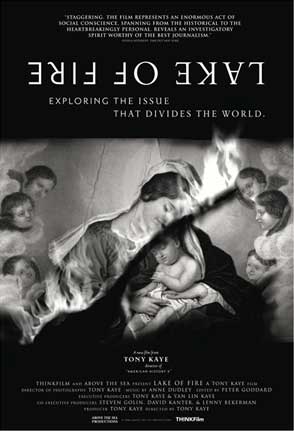
Lake of Fire - a documentary on abortion

Last week a blog I frequent recommended this documentary on the abortion issue. It is an issue I have committed to be more informed about and active in year round, not just in Novembers. So I found Lake of Fire in the library and watched it in two sittings, the kids afternoon naps and tonight once I got them in bed. Honestly, I was glad to break it up like this because it is not an easy film to watch. Here are a few of the reasons why:

1. The constant connection drawn between religious fundamentalists and the prolife movement got annoying. I understand that almost all fundamentalists are prolife, but not all those of the prolife persuasion are fundamentalists. The film makers spent an inordinate amount of time talking to nutjobs, like the guys who believe all blasphemers should be executed (though in a humorous moment the man on camera who made this claim had to ask his pastor off camera what constituted blasphemy). The Christian Reconstructionist Roas Rushdoony and his Institutes of Biblical Law were discussed as though they were widely accepted in the Christian community (ok, for a small number of uberreformed people they might be).

2. The hate and lack of compassion on the anti-abortion protesters/activists was appalling. One of the things that comes to life in this film is the emotional turmoil the women seeking an abortion often go through before, during and after the procedure. It was heartbreaking. While we should be concerned for the unborn life, we must not forget the life of the women either. (And don't forget the men. There's a moving scene in the beginning of the film recounting the story of a young man who tried in vain to convince his girlfriend to keep the child. He experience loss and pain as well).

3. The lack of intellectual dialogue was disappointing. This isn't a film where you'll find the best articulation of prolife positions. While I felt the prochoice position was better represented (they had more big guns on camera) this side of the issue still had it's wacko's. There was one lady who argued that the prolifers she encountered fit the profile of pedophiles. Another woman, a psychologist I believe, argued that prolifers were so angry at the termination of the babies new life (certainly not her words) because they were 'projecting' (her word). They were projecting their own killing, their own taking of new life onto those abortion doctors and that's what enraged them. What did they kill? Creativity and new thought with their dogma! Yeah, that's it. That's why they are so mad. Stupid.

4. That no one followed the slippery slope of the prochoice arguments to their logical conclusions was frustrating. Alan Dershowitz, a man whose life and intellect I greatly respect, is particularly guilty of this. He describes seeing his daughter in a sonogram and thinking, "that's my daughter, I can't conceive of not letting her live. She's a baby" [my paraphrase]. Yet, that doesn't bring him to a prolife position. He goes on to say, "but that was because we had decided to keep her. If we had decided not to, would I have felt the same way? I don't know" [again, my paraphrase]. I want someone to ask him, "what if I don't want my two year old? What if I don't want my elderly parents when they get to be a nuisance?" Since when did being wanted become the defining characteristic of personhood, or more importantly, human life.

Another extreme example of this was the line of argument offered by Peter Singer. He asks, quite bluntly, "what makes killing wrong?" He argues that since they baby doesn't care what happens to it we shouldn't be overly concerned either. He argues that taking a innocent human life isn't always wrong. He states that a fetus can't feel pain or satisfaction until at least 18 weeks. A utilitarian calculation should weigh the woman's desire to have the abortion, the fetus' desire to live and not feel pain. So, he argues, since a fetus has no desire to live and cant' feel pain, the mothers desire overrides other concerns. Ok, but what about me when I'm asleep. I don't want anything. If you killed me quickly I wouldn't feel pain. His argument is slippery in the extreme!

5. The confusion of issues was nonsensical at times. It was asserted repeatedly, in passing, that prolifers were anti women, racists, etc. Ok, lets just grant for the sake of argument that prolifers are all racists. Does that negate the validity of their arguments? It's an awful example of an an ad hominem argument (don't wrestle with the idea, attack the person).

6. The reminder that I've been used by the Republican Party is infuriating. It was said (can't remember by whom), that most Republican politicians don't want abortion to go away - it's how they raise money and punch their ticket to Washington. I think the commentator is right.

7. It is very disturbing. At first I was disappointed the film was in black and white. After they showed in graphic details the first abortion procedure being done, I was grateful. Honestly, I almost threw up. There were two procedures shown in detail, not to mention very graphic pictures of babies (and of women who had tried to perform abortions on themselves before it was legal). There is also a very lude scene with an all female rock band - just a warning.

8. It was incredibly challenging.
- In a speech given to a prochoice group, Jocelyn Edwards, former Surgeon General, makes the comment that we care a lot about children when they are in someone else's uterus. As a nation, we are failing to care well for the massive numbers of children who live in poverty, without health care, hungry and helpless. She's right, and shame on us prolifers.
- Noam Chomsky makes a similar point when he reminds the viewer that some 15 million children die each year from preventable diseases and fixable situation (ie. no access to clean water). His point - if you're prolife, be consistent and others may be more willing to listen to you.
- According to one expert, botched abortions were the leading cause of death in women ages 15-45 during the 1950's. That should guard us against any Pollyannish notions that overturning Roe v. Wade would end the tragedy of abortion. We must deal with the root issues, including the loosening of the connection between sex and marriage, but also the cultural/societal structures that make carrying a baby to delivery so undesirable. In short, we must step up efforts to care for women as well as babies.

For me, one of the high points of the film was listening to Norma McCorvey ('Jane Roe'), tell of her conversion and subsequent shift in thinking on abortion. It really is a story of grace. The film is one I would strongly recommend to everyone but kids. Be prepared and be open to being challenged.

Thursday, February 12, 2009

Is Abortion a Private Issue?

Yesterday I took a few minutes and sent a letter to my Congressman urging him to sign the Jordan/Schuler letter to Nancy Pelosi encouraging her to keep the prolife 'riders' in upcoming appropriation bills ('riders' prevent taxpayer dollars from being used to promote or perform abortion, protect the consciences of health care, professionals, and prevent funding for unethical human embryo experiments). While the Freedom of Choice Act has not yet been introduced, there is a proper fear that many parts of this ghastly bill are being stealthily snuck into the Stimulus Package. Jordan and Schuler are "requesting that the pro-life riders be included in any legislation reported out of the Appropriations Committee. If the riders are not added to the appropriations bills, then we are asking the Rules Committee to report a rule that allows for consideration of any deleted riders on the floor of the House of Representatives. We believe that failure to include all of the current policies with regard to the right to life will mark a radical departure from a policy many Americans support." I would encourage you to write/email your Congressman and encourage them to sign the letter as well.

I definitely appreciate the fact that my Congressman (or a staffer) took the time to respond to me. While I don't know if he will sign the letter, he did point out that he opposes partial birth abortion and voted yes on H.R. 3660, the Partial-Birth Abortion Ban Act of 2000. Also, he voted for H.R. 1218, the Child Custody Protection Act, which would "make it a federal crime for an adult, other than a parent, to transport a minor across state lines to have an abortion in order to circumvent parental consent laws." He also voted for H.R. 2436, the Unborn Victims of Violence Act which "would impose criminal penalties on people who, through violent acts against pregnant women, cause prenatal injuries or terminate pregnancies." Finally, he pointed out that he is a cosponsor of H.R. 1074, the Reducing the Need for Abortion and Supporting Parents Act, which "aims to reduce the abortion rate by preventing unintended pregnancies, supporting pregnant women, and assisting new parents."

I am very appreciative of his efforts to reduce the number of abortions and his willingness to stand for life in these ways. I am hopeful that HR 1074 will have a big impact on the number of women seeking to have an abortion.

Having said that, I am also somewhat puzzled by the conclusion to his email. He writes, "While I personally oppose abortion, I ultimately believe abortion is a private matter in which the federal government should not be involved." I am confused, in part, because the majority of the email was spent showing the ways he has, as a government agent, supported government involvement in the issue.

More to the point, however, I need clarification on why the taking of life is strictly a private matter and not an issue that government should involve themselves in. I am sure that the Congressman and others of this opinion do not see fetus' (at least those that are not viable outside the womb) as fully human. This then, in their mind, is the great difference between abortion and infanticide (which I am sure he would be opposed to). But in what way exactly is a fetus different. Is it different because it is dependent upon the mother for survival? So are most six month olds. Certainly independence isn't a test of personhood. If it was, many elderly would not be considered full persons (fully human). Is the fetus different anatomically? No, not really. Hearts start beating before week 6 and the head, eyes, liver and intestines are forming as well. Is it different with regard to DNA? No.

My point is that any distinction between a fetus (who is not protected under law) and a person (who is) is completely arbitrary and sets us down a slippery slope of determining which lives are valuable and deserving of protection and which are not. John Piper makes this point clearly, relying on the logic of Abraham Lincoln (appropriate today, Lincoln's birthday). Piper's Jan 22nd blog post (in part):

What are the differences between this child before and after birth that would justify its protection just after birth but not just before? There are none. This is why Abraham Lincoln’s reasoning about slavery is relevant in ways he could not foresee. He wrote:

You say A. is white, and B. is black. It is color, then; the lighter, having the right to enslave the darker? Take care. By this rule, you are to be slave to the first man you meet, with a fairer skin than your own's.

You do not mean color exactly? You mean the whites are intellectually the superiors of the blacks, and, therefore have the right to enslave them? Take care again. By this rule, you are to be slave to the first man you meet, with an intellect superior to your own.

But, say you, it is a question of interest; and, if you can make it your interest; you have the right to enslave another. Very well. And if he can make it his interest, he has the right to enslave you. (“Fragments: On Slavery")

There are no morally relevant differences between white and black or between child-in-the-womb and child-outside-the-womb that would give a right to either to enslave or kill the other.

Wednesday, January 28, 2009

Questions about Scripture #4: If the Bible is authoritative, how do we take those passages in the Pentetauch which permit slavery?

I am forced to paraphrase this question from memory because the piece of paper is on my desk at church and I'm snowed in at home. The question, 'if the Bible is authoritative how do we handle the passages in the OT that permit slavery', is one I wish I had a whole semester to think about before answering (I have this wonderful 500 pg. book on my shelf by Christopher Wright, Old Testament Ethics for the People of God. Unfortunately I only got it a week or two ago and haven't read it yet. I am drawing heavily on several sections though). This will be a long post, but stick with it.

To begin, when thinking of slavery in ancient Israel we must put all images of modern slavery or of slavery in the US prior to the 1860's out of our mind. In fact, we must put all images of slavery in the ancient world out of our mind. Slavery in OT was utterly different, unique and stands in stark contrast. There were no slave markets, slave ships, neck irons, sugar plantations, etc. Slaves worked alongside owners and the owners children in the fields and home - they didn't instead of their owners but with them. Wright says that the experience of a slave was little different than the experience of a paid worker. Most slaves were debtors working off their debts as bonded servants. An owner could not sell his slaves. They were not kidnapped from another place and forced into slavery. Consider Deuteronomy 24:7, "If a man is found stealing one of his brothers of the people of Israel, and if he treats him as a slave or sells him, then that thief shall die. So you shall purge the evil from your midst."

This leads Wright to argue that slave isn't even a good word because of all that baggage we carry - 'bonded servant' is the phrase he prefers). Wright comments, "slaves enjoyed more legal rights and protection than in any contemporary society. Indeed, slaves enjoyed more explicit legal and economic security thatn the technically free, but landless, hired labourers and craftsmen". I'm not sure I'd use the word 'enjoyed' but the point is made nonetheless. Slavery as we see it in ancient Israel is categorically different that what we usually associate with the word slave.

Moreover, Wright points out "slaver in the Old Testament was not simply tolerated with a 'rubber stamp' of uncritical approval. Aspects of Old Testament thought and practice in this area virtually 'neutralized' slavery as an institution and sowed the seeds of its radical rejection in much later Christian thining." How so? Wright makes three points:

1) Israel had herself been delivered from slavery to Egypt by God. The command "You shall remember that you were a slave in the land of Egypt, and the Lord your God redeemed you" (Deut. 15:15) shows up at least six times, variously worded, in the books of Exodus and Deuteronomy. Their slavery was harsh and long - 400 years. As a nation, they began as a rabble who had been freed from bondage. Thus, Israel's whole understanding of slavery was formed against the backdrop of her own suffering under her Egyptian masters.

2) As mentioned above, the laws regulating slavery in Israel were more favorable to slaves than the laws of any of the surrounding nations. For example, slaves were included in the religious life of Israel, including Sabbath rests. In addition, there are many laws for Israel that govern how a master could treat his slaves. Wright points out that in and of itself that is unique. In other nations there were laws regulating what you could do to someone elses slave but no laws restricting what you could do to your own slave. If a slave was permanently injured by his master, he was to be set free. According to Exodus 21:20, if a master beat his slave so that he died immediately, the slave was to be 'avenged'(meaning the master was liable to death at the hands of the dead slaves family). Full disclosure here, the next verse is harder. It says if the slave is beat and survives a day or two his death is not to be avenged (apparently, that he survived a couple of days was seen as evidence that the master did not mean to kill the slave). All this talk of beating is tough, but remember, children and wives were beat too! Ouch. I'll come back to this at the end.

Maybe most importantly, a slave was to be set free after six years of service. Since many didn't own land and would find survival difficult they would choose to remain as slaves. This is evidence that for many, slavery was less oppressive and more secure than abject poverty.

Deuteronomy 23:15-16 takes the prize as the best anitslavery law: "You shall not give up to his master a slave who has escaped from his master to you. He shall dwell with you, in your midst, in the place that he shall choose within one of your towns, wherever it suits him. You shall not wrong him." If a master was harsh, his slaves could flee without reprucussion. It was their prerogative. Some have argued that this must have applied to foregin slaves that fled to Israel for refuge. Even if that's true, and I don't see anything in the text that supports that interpretation, it would be a radical departure from other nations slave laws. This, in effect, undermines the whole institution of slavery.

3) The attitude towards slavery in the Israel is different in that it assumes the equality of all mankind. All are created in the image of God. All bear an inherit dignity (see Job 31:15). Slavey is not natural; slaves are not something less than owners. In Wright's words, "Slavery here is sen as something unnatural, fallen and accursed".

This brings me to my second to last point. The OT legal codes were designed to restrain evil. For example, the laws regulating divorce do not mean God approves of divorce. It is contrary to his design and purpose. God, however, understands fallen man and fallen societies. Jesus' comments regarding divorce are informative (see Mark 10:1-9). Moreover, what we are looking at here are laws. Ethics are different than laws. Simply obeying the laws does not make one ethical. Rightouesness goes beyond simple law keeping. Laws are designed to restrain evil, not necessarily establish righteousness. So, though slavery was legal (as was wife beating and child beating, within limits), it does not follow that Scripture teaches it was a righteous thing.

Now, finally, my last point. I don't want to leave anyone with the impression that I believe slavery is ethical. Not for a minute. I believe slavery is evil, even the kind tolerated under the Israel's law. However, one might look at how modern societies have dealt with the same underlying problem, namely poverty and debt, and wonder if our solutions are any less evil. Those who are down and out can declare bankruptcy (and the creditors get nothing, which certainly isnt' just) or sometimes the debtors are imprisoned (which helps no one). The gravely impoverished live sometimes without the necessities of life - food, clothing, shelter, etc. In a fallen world sin affects everything. It creates problems for which the best solutions are sometimes undesirable - like going to war to prevent atrocities. As shown above, many Israelites considered becoming a slave a better option than living in abject poverty, landless/homeless, etc. Wright comments, "considered simply as a legal penalty [for defaulting on debt], it is arguable that time limited slavery for debt on Israelite terms was more humane than imprisonment on ours. The slave still lived at home. he worked with human company in the 'normal world. he walked on God's earth under God's sky. Imprisonment denies these things, and it is interesting (to say the least) that imprisonment is never prescribed as a penalty anywhere in the Torah (though it was practiced in the later monarchy)." Am I advocating a return to indendured servitude to solve these problems today. No, of course not. But a sympathetic reader of the OT can't miss the compassion inherint in Israels slave laws. Hope that helps.

Thursday, December 04, 2008

The Worst Christmas Present Ever, Seriously.

This one is appalling.

"A number of Planned Parenthood clinics in Indiana and Illinois are offering gift certificates for their services this Christmas.

Officials say the vouchers enable people to give their loved ones "the gift of life" — that would help pay for annual checkups and birth control — but also can be used for abortions."

Read the whole article...

Wednesday, November 19, 2008

Another Perspective on Gay Marriage

I stumbled across this article today which offers a very different perspective, one that I'll need to mull over more thoroughly, on the same sex marriage debate. Summary: Prop 8 in Cali. is more tolerant and liberal than laws in Mass. demanding same sex marriage be recognized. Hmm.

Read the whole thing.

Friday, November 07, 2008

Clarification on Previous Post on Gay Marraige

In the comments on my previous post, SEG asked for some clarification on why I am for using the legislative process to put an end to abortion but not a fan of the ban on gay marriage. First, let me say that I am not for gay marriage and do believe homosexuality is a flagrant sin (one of many). But I think there is a difference between the two issues, abortion and gay marriage.

Here's the difference as I see it, and I am open for correction and input. First, I see nowhere in scripture where I am to crusade in the larger society for morality. We should be moral people and salt and light that change society from the inside out. I do see, however, where we are called to stand up for the weak, the powerless, to care about justice, etc. In most ways, the gay marriage issue is a victimless issue. We obviously can't say the same thing about abortion.

Secondly, changing the terminology from marriage back to civil union is semantics - just wording. Now I really haven't spent time reading the legislation, but I am under the impression that virtually all of the rights extended to gay couples under the umbrella of 'marriage' will continue to be extended under the umbrella of 'civil union'. No matter what you call it the sin remains. To change that, you'd have to outlaw homosexuality (sodomy laws, etc.) and enforce it. I don't know many people who are in favor of this, and I certainly am not. On the issue of abortion, I'm not advocating action to protect a word or concept, but lives.

Hope the clarification is helpful.

Wednesday, November 05, 2008

Gay Marriage and Constitutional Bans

A few weeks ago I mentioned that I'm not one who supports amendments to the Constitution banning gay marriage. Yesterday three states passed amendments to their state constitutions banning it. Here's a quote from William Duncan on marriagedebate.com:
Voters in California, Arizona and Florida approved constitutional amendments defining marriage as the union of a man and a woman yesterday. This is great news for marriage.

The California victory is especially important since it reversed the California Supreme Court’s redefinition of marriage in May of this year. The Florida victory is significant because the amendment there needed sixty percent approval to be enacted. The Arizona victory reversed the very narrow defeat of a slightly more complicated marriage amendment in 2006.


First, I should say I'm not necessarily opposed to constitutional amendments banning gay marriage, I'm just not for them. I'm very ambivalent, but do think advocacy for and money spent to promote such bans are a complete waste.

Going back to the quote I can explain why. First, Duncan says this is great news for marriage. I really and truly fail to see how such amendments will make make marriages better. Will they lower divorce rates, increase fidelity or anything else that could be considered good news for marriage. Secondly, I don't get the personification of marriage - as if marriage is now celebrating.

More importantly, I don't see how this truly changes anything except in name. Civil unions are still protected legally and gay individuals in civil unions are still provided the same rights, essentially, as married couples. Frankly, a rose by any other name is still as sweet. I don't care if you call it a civil union or a marriage. Civil unions are marriages in all but a legal sense.

Now please, understand I'm not advocating a gay lifestyle. I think its sinful, but lets work at addressing the sin and stop quibbling over words.

Finally, I question why Christians care so much about how the state defines marriage. Will I allow the state to define for me or my kids how we should understand marriage. Until the day the state tells me I have to perform gay marriages, I just don't care if a gay couple gets hitched at a courthouse. 'Whatever' I think is the proper response.

Tuesday, October 21, 2008

the eternal life of money?

Change of topic for a while. I read this today in Christopher Wright's excellent book The Mission of God. He quotes Geiko Muller-Fahrenholz at length (Jubilee Challenge, pp. 104-111). I thought it was timely given the financial instability of the past few weeks:
We enjoy time, we are carried along in the flow of time, everything is embedded in its time, sot the very idea of exploiting the flow of time to take interest on money lent seemed preposterous. It does so no more because the sacredness of time has disappeared, even before the sacredness of the land vanished from the memories of our modern societies. Instead capitalist market economies have been elevated to global importance'; they are enshrined with the qualities of omnipotence that border on idolatry. So the question arises: does it make sense to attribute to money qualities that no created thing can ever have, namely eternal growth? Every tree must die, every house must one day crumble, every human being must perish. Why should immaterial goods such as capital - and it's counterpart, debts - not also have their time? The capital knows no natural barriers to its growth. There is no jubilees to put an end to its accumulative power. And so there is no jubilee to put an end to debts and slavery. Money that feeds on money, with no productive or social obligation, represents a vast flood that threatens even large national economies and drowns small countries...But at the heart of this deregulation is the undisputed concept of the eternal life of money.